

Marks: Darul Uloom Deoband
An integral part of the fabric of the ummah, or the Muslim world at large, is the seminary or madrasa, Darul Uloom Deoband, located in the North Indian town of Deoband in the state of Uttar Pradesh. Its inception on 31 May 1866 (15 Muharram 1283 AH) was more than just the beginning of a school.
A Response to Collapse and Colonialism
With the dissolution of the entire Mughal Empire and the formal beginning of the rule of the British Raj, this patronage network was essentially destroyed. The leaders of Darul Uloom realized that struggle by arms was futile against the British (as evident in the way ‘ulama participated in Battle of Shamli) and an intellectual defense was required.
- The Intellectual Architect: The idea of this new education model was largely the brainchild of Maulana Muhammad Qasim Nanautavi (1832-1880), known to his devoted adherents as Hujjat al-Islam. Nanautavi brought to the Deoband movement modernity in administration, including the use of class-room education, a structured curriculum (an adaptation of Dars-i Nizami patterns), teachers, and examinations to provide for the efficiency of religious education.
- Custodian of the Initiative: History marks Sayyid Muhammad Abid as the founder of the initiative. It was he who initiated the teaching sessions in the courtyard of the Chhatta Masjid mosque, which had one teacher (Mulla Mahmud Deobandi) and one student (Mahmud Hasan Deobandi, also known as Shaikhul Hind).
- The Principle of Public Trust: Nanautavi established the Eight Fundamental Principles of the running of the seminary. The most radical of these was the use of public contributions in the form of chanda rather than government or elite patronage. This varied from other similar existing institutions such as Aligarh in that it guaranteed the school the freedom of knowledge and thought.
A Lasting International School of Thought
The Deoband Madrasah grew into one of the leading Islamic learning institutions, frequently rated second only to the prestigious Al Azhar University of Cairo in the Islamic world. It spawned the broader Deobandi movement, which is an international phenomenon with a commitment to:
- Religious Purification: The promotion of a return to a pure version of the teachings of the Qur’an and the Sunnah, and a purification within local Muslim communities of bid’ah (‘sinful’ 2. Morals and Spiritual Development: Imparting strict Islamic morals, or taqwa, in their students with a view to raising devoted Islamic leaders. The oldest Islamic seminary worldwide is today a “center of Islamic culture” and a vanguard of Sunni Muslim identity for the Indian subcontinent and its diaspora, as its alumni have opened thousands of affiliated madrasas all over the world.
The History of Darul Uloom Deoband: A Story of Revival and Resistance
The history of Darul Uloom Deoband is more than the history of a school; it is the history of the large Islamistic revivalsistic movement, which grew from the ruins of the Mughal Empire, created by the trauma of British colonial policies.
1. The Crucible: Post-
The formation of Darul Uloom Deoband was an immediate reaction to the tragedy faced by the Muslim community in the aftermath of the Great Revolt of 1857.
- The Collapse of Patronage: The British takeover from the East India Company, coupled with the deposition of the last Mughal emperor, led to a disastrous collapse of patronage covering Islamic education. The Muslims felt that their religious heritage was directly challenged by colonialism and Christian missionaries.
- The Shift in Strategy: After having taken an active (though unsuccessful) part in military resistance against the British (for example, The Battle of Shamli in 1857), researchers came to understand that only an intellectual and spiritual struggle could preserve Islamic culture and know-how.
2. The Foundation (1866): Eight Principles of Independence
The seminary was founded in the small town of Deoband, in the Saharanpur district of what is now Uttar Pradesh, on a revolutionary model of religious education.
- Date: 31 May 1866 (15 Muharram)
- Principal Initiator (The Pioneer): Sayyid Muhammad Abid, whose initiative began the fund-raising and the teaching activity in the courtyard of the Chhatta Masjid. It is usually attributed to him by early sources as the person who founded this madrasa (bānī wa mujawwiz awwal).
- The Intellectual Architect (The Principal Founder): Maulana Muhammad Qasim Nanautavi (1833-1877) formed the intellectual base. He has been repeatedly portrayed in later historical narratives as the principal founder (*bānī-yi aʿ
- The Spiritual Guide: Maulana Rashid Ahmad Gangohi (1826-1905) was a renowned Hadith and Fiqh authority and an important intellectual/spiritual anchor for the emerging party.
- The Educational Innovation: The augmented curriculum was a modified version of Dars-i Nizami but featured a novel, organizational structure that included dedicated classrooms, a syllabus, teachers, exams, and a focus on rational sciences to transmit traditional text knowledge.
- Revolutionary Principle: The school was dependent solely upon public donations or chanda. This principle brought about the school’s independence both financially and ideologically from the British government, distinguishing it sharply from other educational plans of the time, viz., Aligarh Movement.
3. Early Decades and Political Awakening
There was a strong
Under the stewardship of the initial administration members (Muhtamim) and teachering staff, Darul Uloom established itself rapidly as an example for the rest of the seminaries in the subcontinent.
- First Teacher and Student: Mulla Mahmud Deobandi was the first teacher, and his student, Maulana Mahmud Hasan Deobandi (later known as Shaykh al-Hind), became the first student and later a principal figure of its political history.
- The Anti-Colonial Stand: The tradition retained the ethos of Jihad (struggle) against colonialism. The most important political movement was the Silk Letter Movement (Reshmi Rumal Tehrik), which was conceptualized by Shaykh al-Hind Maulana Mahmud Hasan in the early 20th century. It aimed to dislodge the British Government through a alliance with the Ottoman Empire, Germany, and Afghanistan. It was detected, and he, along with his followers (mainly Maulana Husain Ahmad Madani), was detained in the Maltese Islands for a number of years.
4. The Role in India’s Freedom Movement
The Deobandi ulama in the 20th century actively participated in politics against the British.
- Origin of Jamiat Ulema-e-Hind (1919): The Deobandi school of thought created a strong political party that supported the Indian National Congress.
- Composite Nationalism: The preeminent political leader of the Deobandi school, Maulana Husain Ahmad Madani, vigorously supported the idea of Muttahida Qaumiyat aur Islam (Composite Nationalism and Islam), where he believed that Muslims and Hindus could and should constitute one united Indian nation against the colonial power. He opposed the demand for the partition of India by the Muslim League.
- The Split (1945): A faction of scholar ulama, consisting of Maulana Ashraf Ali Thanwi and Maulana Shabbir Ahmad Usmani, differed in their opposition to the partition position and opted to join the Muslim League, and as a result, Jamiat Ulema-e-Islam (JUI) was created. ### 5. Global Reach and Modern Era Since the time of Partition in 1947, the Darul Uloom Deoband in India has continued to be one of the most essential parts of Islamic education systems available to * Transnational Influence: Deobandi influence was not restricted to the Indian subcontinent; it reached the international level through its university-trained followers in Pakistan, Bangladesh, the U.K., South Africa, and other countries. It was responsible for establishing thousands of “madrasas” all over the world. * Present Role: Today, the Darul Uloom Deoband is acknowledged to be one of the largest forums in the world for the study of the Jurisprudence of the Sunni school of thought and the study of the Hadith. The religious rulings or fatwas issued by it have a very significant impact and form the Islamic discourse for millions of people across the world.
Administrative and Historical Archives

The Darul Uloom Deoband, being a traditional Islamic learning institution that is financially autonomous due to public donations, has a unique set of archives that are essential to its history and output. These archives are imperative to any scholar who may be carrying out studies on the institution and the Deobandi movement and Islamic history in the subcontinent.
Here is the overview of important records and archives of Darul Uloom Deoband.
The organization has a department specifically for historical papers to ensure the founding and development of the organization are well preserved.
1. Muhafiz Khanah (Arch
This department, whose current building is a legacy of the year 1937, deals with the protection and documentation of all the historic records of Darul Uloom. This department maintains the entire record of the original documents of the institution.
2. Annual Reports (Roodad
The seminary has published detailed annual reports since its first year, that is, since 1283 AH / 1866 CE. The reports, initially published in Urdu, record all its financial, professional, or administrative activities. The annual reports remain a crucial historical document since they record details regarding:
- Names of founders and successive administrators.
- Budget, sources of income (principally public donations), and expenditures, emphasizing the transparent nature of its finances.
- Educational advancement, student enrollment statistics, and the list of graduating scholars (Fazil).
3. The Eight Principles (Usul-e-
Although not a “record” of the physical kind, the written form of the Eight Basic Principles enunciated by Maulana Muhammad Qasim Nanautavi is the most important constitutional record. The principles shaped the structure and its autonomy, which included autonomy in dependence on public contributions.
4. Biographical Accounts (Tadh
There has long been the tradition of biographical writing (Tadhkirah or Sawanih) about the pioneer figures and leading Ulama (scholars). The key texts include:
- Sawānih-e-Qāsmī (Biography of Qasim Nan
- Ulāma-e-Hind Ka Shāndār Māzi (The Illustrious Legacy of Indian Ulama
- Tadhkira Mashā’ikh-e-Deoband (Memo
Such volumes may include historical tales, correspondence, as well as in some cases copies of founding charters. In some instances, these publications are printed by the press of the Darul Uloom.
Library and Scholarly Records
The Darul-Ulloom Deoband is basically an institution of knowledge and the collection of the library there can well be termed the greatest treasure there.
1. Shaikhul Hind Library
This library is named in honor of the renowned scholar, Maulana Mahmud Hasan Deobandi, and is one of the largest collections of Islamic literature in the South Asian region.
- Book Holdings: This library consists of more than one hundred thousand books, mainly in Arabic, Persian, and Urdu, including the whole gamut of traditional Islamic sciences, as per one record in 1950; the number is probably much more than that at the present time.
- Rare Manuscripts: The library possesses a vast collection of rare manuscripts, with more than 1,500 rare manuscripts on diverse topics such as Unani Medicine, law, history, and Sufism, ranging from 800 years back to present.
This includes: - “Aurangzeb Alamgir’s Handwritten Copy of the Holy Quran”.
- A 750-year-old manuscript of animal-related works by Imauddin Zakaria
Hundreds of Manuscripts Related to Sufism
2. Fatwa Records (Darul Ift
Every year, thousands of fatwas (religious rulings) are issued by the Darul Ifta (Department of Religious Edicts) in response to queries put by Muslims all over the world. These fatwas are carefully indexed and recorded. Although these modern fatwas are currently available online, the physical archive is an enormous and precious resource reflecting the consideration of Hanafi jurisprudence to practical social and legal issues over the passage of years.
Publications and Periodicals
The organization publishes journals and magazines that often yield institutional news, research articles, and official announcements.
- Monthly Darul Uloom : The Urdu monthly magazine of the Darul Uloom.
- Al-Daie: This was the name * ***Majlatul Nahdhat al-Adabiyy * **Aaeenah Darul ‘Uloom**: An Urdu fortn These publications are a kind of chronology of the seminary’s intellectual and political positions on various contemporary issues. If you are a researcher and/or are seeking a certain type of information, I suggest visiting the online resource available to you via the official web pages of Darul Uloom Deoband, which contain digitized records and fatwa collections, or reading books written about the historical aspect of the Deobandi movement.
How to Reach
How to Reach Deoband: A Comprehensive Travel Guide from Delhi
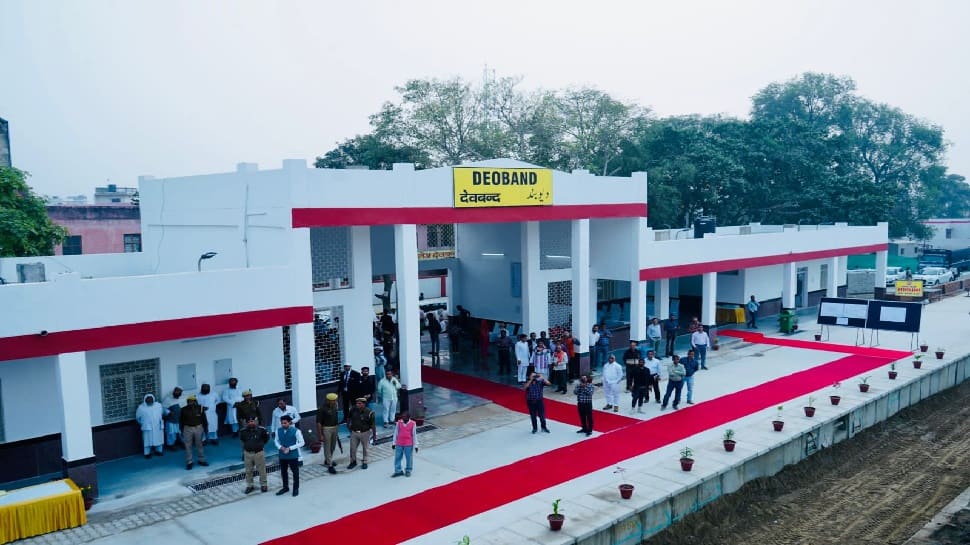
Deoband is a town of historical and religious significance in Uttar Pradesh; it attracts much attention from tourists, especially those coming to the Darul Uloom seminary. With its location about 150-185 km north of Delhi, reaching there is easy, and one can enjoy excellent connectivity by rail and road.
Here is a detailed guide on the best ways to travel from Delhi to Deoband.
- By Train: Fastest and Most Convenient
The railway is considered a generally preferred and very efficient way to travel directly to Deoband.
Key Details
DBD- Deoband Railway Station.
- Distance: About 140–150 km.
- Journey Time: 1 hour 35 minutes to 3 hours.
Popular Trains
Deoband falls on the main line and connects Delhi with Saharanpur, Haridwar, and Dehradun, hence is quite frequented.
| Train Name/No. | Origin Station (Delhi) | Approx. Travel Time | Class Availability Options |
|---|---|---|---|
| Vande Bharat Exp (22457) | Anand Vihar (ANVT) | 1 hr 36 mins (Fastest) | EC, CC |
| DDN Janshtbdi (12055) | New Delhi (NDLS) | 2 hrs 12 mins | CC, 2S |
| Utkal Express (18477) | Hazrat Nizamuddin (NZM) | 2 hrs 51 mins | 1A, 2A, 3A, SL |
| Chattisgarh Exp (18237) | Hazrat Nizamuddin (NZM) | 2 hrs 44 mins | 1A, 2A, 3A, SL |
Pro Tip: Book in advance, especially in high-demand trains like the Vande Bharat or Jan Shatabdi, to get the best seating class and time slots. The Deoband station itself falls just 3.0 km away from the Darul Uloom and can easily be covered in an auto-rickshaw.
- By Road: Bus and Car Travel
The road journey is flexible and is a good option if the train tickets are not available or if one prefers to travel directly from point to point.
By Bus
The UPSRTC (Uttar Pradesh State Road Transport Corporation) runs several buses daily on this route. ***
- Boarding Points in Delhi: The buses usually start from major terminals like ISBT Kashmiri Gate and Kaushambi Bus Stand.
- Travel Time: 4 to 5 hours (depending on the traffic, especially while going out of Delhi).
- Fare: Very reasonable, around ₹250 onward.
By Car / Taxi
- Distance: About 185 km.
- Route: Via the most common route along the Delhi – Meerut Expressway (NH 334) and then take the diversion toward Muzaffarnagar and Deoband.
- Travel Time: About 3 to 4 hours, thus the quickest, other than the Vande Bharat train.
Pro Tip: You can hire a private taxi or use a ride-sharing service for comfort and directly going there, but negotiate the fare or confirm the fixed price in advance.
- By Air: Nearest Airport
Deoband has no major airport of its own. Visitors flying in from other parts of the country or from other countries have two major options, followed by traveling on the ground:
| Airport Name |Distance to Deoband | Ground Travel Time |
| Indira Gandhi Int. Airport, New Delhi | DEL | ~140 km | 3-4 hrs |
| Jolly Grant Airport, Dehradun | DED | ~75 km | 2-3 hours |
Recommendation: Most international and domestic travelers will arrive at Delhi (DEL) because of better connectivity. The best travel onward from Delhi is the direct train service to Deoband. Dehradun (DED) is relatively closer but generally has fewer flight options. There is a group of six people trying to cross the river during autumn. Best Time to Travel * Winter months, starting from October and continuing up to March, are the time when North India is most pleasant to travel and explore because of cool and comfortable temperatures. * Summer months (April to June) can get brutally hot. Getting Around Deoband When you reach the Deoband Railway Station or Bus Stand, the town center, including the Darul Uloom, is easily accessible. Auto-rickshaws and cycle-rickshaws are available as the common and easy modes of transport for short distances within the town. Always agree on the fare before commencing your journey!
Conclusion: The Enduring Legacy of Darul Uloom Deoband
The Darul Uloom Deoband is much more than simply an 19th-century seminary; rather, it symbolically represents a “living monument to intellectual resilience, religious revival, and cultural self-determination” in the face of colonial challenges.
The essential attributes that define the institution, such as adherence to the traditional Dars-i Nizami syllabus, full public funding that ensures complete autonomy, and the emphasis on Qur’an and Hadith studies, have facilitated the maintainance of a distinctive school of thought among the Sunnis.
In conclusion, there are two aspects to the legacy of Darul Uloom De
- Educational Citadel: It has successfully resisted the tide of cultural assimilation by establishing a system of several thousand madrasas all over the world, becoming a main hub of Hanafi jurisprudence and traditional Islam studies.
- Political and Moral Power: It also generated a powerful indigenous political theology in the tradition of Maulana Husain Ahmad Madani, which formed the rationale for the anti-colonial nationalist and the Indian identity. Today, its impact crosses continents, influencing the religious practices and ideologies of millions of Muslims across the subcontinent and the world at large. The Darul Uloom Deoband continues to be a vanguard of traditional Islamic learning because it maintains the continuity of classical knowledge for the future generation.
Read more Blogs:-https://ghumnechalen.com/rameshwaram/