
What is the Story of behind Establishing the Temple Of Vaishno Devi
The mythological story behind Shri Mata Vaishno Devi and the discovery of the shrine in Katra embodies a tale of divine birth, spiritual penance, and confrontation between good and evil.
Table of Contents
Now, the following is the widely accepted legend that connects Mata Vaishno Devi with the Holy Cave in the Trikuta Mountains near Katra:
Attention!
- The Birth of Vaishnavi Devi.
The story starts in the South of India where a very beautiful girl, Trikuta, was born to a pious couple. She is believed to be created from the combined spiritual energy (Shakti) of the three supreme Goddesses:
- Maha Kali (Goddess of Time and Death).
- Maha Lakshmi (Goddess of Wealth and Prosperity).
- Maha Saraswati (Goddess of Knowledge).
As she grew up, she devoted herself wholly to spirituality and worshiped Lord Vishnu. She was called Vaishnavi because of her devotedness to Lord Vishnu.
- The Penance in the Trikuta Mountains
She went north to the Trikuta Mountains (near present-day Katra), where she undertook rigorous penance and meditation to attain the highest state of spiritual emancipation.
It was during her penance that Lord Rama, (an avatar of Vishnu), came across her. Recognizing her as a divine force, he told her to remain in her spiritual pursuits and that he would marry her in his form as Kalki in the Kaliyuga or the current age. He also instructed her to continue serving and helping people, as that was the essence of her divine mission.
- The Encounter with Bhairon Nath
At the same period, the existence and the exceptional spiritual powers of Vaishnavi became known to a mighty but egoistic Tantric, Bhairon Nath, the disciple of Guru Gorakh Nath.
- The Feast (Bhandara): Once, as a young girl, Vaishnavi helped her devotee, the humble Pandit Shridhar of Hansali village near Katra, to miraculously arrange a huge feast for hundreds of mendicants and devotees, including Bhairon Nath.
- The Pursuit: Astonished by her powers and enchanted by her beauty, Bhairon Nath decided upon testing and pursuing her. Vaishnavi, having taken a vow of celibacy and wanting to continue her penance without interference, fled into the mountains.
- The Divine Stops: While being pursued by Bhairon Nath, she halted at the following places, which are now considered sacred stops along the pilgrimage path:
- Banganga: Where she struck the ground with her arrow to bring forth water.
- Charan Paduka: Where her footprints are imprinted on a rock.
- Adkuwari (Ardhkuwari): Here she took refuge for nine months in a small cave, just like the baby in the mother’s womb, Garbhjun.
- The Final Confrontation and the Boon
Finally, Bhairon Nath discovered her near the Holy Cave (the Bhawan). When he attempted to enter the cave, Vaishnavi realized the time had arrived to end his evil intentions and to fulfill her own purpose; she took the form of Maha Kali.
- She confronted him, and in the end, beheaded him with her trident.
- The head of Bhairon Nath fell on a far off peak, which is known as Bhairon Ghati or Bhairon Temple.
At the end, Bhairon Nath realized his mistake and repented before his death. Vaishnavi knew that his ultimate desire was salvation (moksha), so she forgave him and gave him a boon:
“The pilgrimage to my shrine will not be complete unless the devotee also visits your temple after having my darshan (sacred sight).”
- The Establishment of the Temple at Katra
Thereafter, Mata Vaishnavi resolved to shed her human form and merged her light into three natural rock formations (Pindies**) inside the Holy Cave. Traditionally, the discovery and formal establishment of the shrine are attributed to one *Pandit Shridhar*, a humble priest from the village of Hansali. It is believed that an anguished Shridhar, following the dinner and disappearance of Vaishnavi, had a divine dream in which the Goddess showed the way to the Holy Cave and the Pindies to him, instructing him to worship them. * Shridhar searched and ultimately found the cave, and spent the remainder of his life worshipping the three Pindies there, consequently bringing the shrine to the knowledge of the world. The town of Katra thus came to be considered the base camp and the cave in the Trikuta Mountains was treated as the sacred shrine of Shri Mata Vaishno Devi.
“Complete Travel Guide to Vaishno Devi Katra: Route, Stay & Tips”
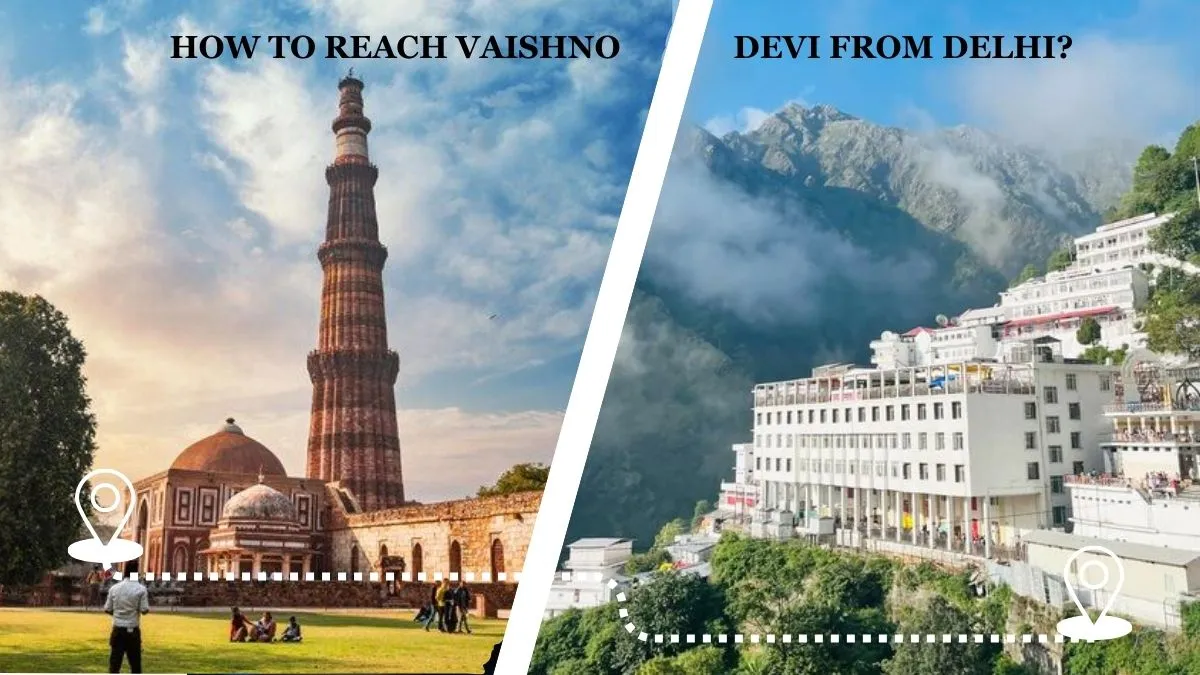
I.Delhi to katra (Ways)
By Train-
This is the most preferred method because it has a direct connection to Katra railway station (SVDK).
| Train Option | Travel Time (Approx.) | Key Features |
|---|---|---|
| Vande Bharat Express (Fastest) | 8-9 hours | High-speed, modern, and comfortable. Runs 6 days a week. |
| Shri Shakti Express | 10-12 hours | High-demand overnight train, good to save one day of travel. |
2. ✈️ By Flight (Fastest Overall)
Direct flight avaible from delhi to jammu. After by train or by road reach katra.
3. By Road (Budget & Flexible)
Self-Drive/Private Taxi: It will take around 11-14 hours depending on your speed and stops. The route would go via cities such as Karnal, Ludhiana, and Pathankot.
- Bus: Daily bus services to Katra Bus Stand are available from ISBT Kashmiri Gate (Delhi) under both government and private operators, with services like AC Sleeper/Volvo. It takes approximately 12-15 hours. This is the most economical way of traveling.
- Location: Available free of cost at the Yatra Registration Counter (YRC) near the Katra Bus Stand/Katra Railway Station (Niharika Complex).
- N.B: Without it, you will not be allowed to pass through the first checkpoint, Banganga.
Options available for the Yatra
| Walking (Trekking) | 12-13 km (5-8 hours) | For fit pilgrims and those who want the classic experience. | The path is of cemented, covered, and has proper lighting. |
| Battery Car | Available from Ardhkuwari to Bhawan. | Best for senior citizens, people with disabilities, or those who want to conserve energy. | Must be pre-booked online through the SMVDSB official website.
| Pony/Mule | Available from Katra. | Traditional alternative to walking. | Negotiate the price only at the official counters; check for the official rate list. |
| Palki (Palanquin) | Obtainable at Katra. | Suitable for older persons and those who cannot walk. | Carried by 4 porters. Check official rates. |
| Helicopter | Katra Helipad to Sanjhichhat (Near Bhawan). Fastest way to reach the top. Takes approx. 8 minutes. Must be booked online in advance. From Sanjhichhat, it is a 2.5 km walk to the Bhawan. |
III. Accommodation and Stay in Katra
Katra has a range of accommodation options to suit:
| Category of Stay | Description | Booking Tips |
|---|---|---|
| Shrine Board Accommodation | The facility provided by Shri Mata Vaishno Devi Shrine Board (SMVDSB) also includes guest houses at Niharika Bhawan, Shakti Bhawan (Katra), Adkuwari, Sanjhichhat, and Bhawan. | Very clean, subsidized, and secure. Must be booked online on the official SMVDSB website weeks in advance. |
“Exploring Katra: The Gateway to the Holy Shrine of Vaishno Devi”

- 1. Banganga (Ban Ganga):
- Significance: It is considered as the very beginning point of the official trek. Also, it is a compulsory checkpoint for Yatra Access Card/Slip. According to legend, Mata Vaishno Devi created this river by striking the ground with an arrow to quench the thirst of Hanuman.
- Experience: Devotees take a holy dip in the crystal-clear water before starting the climb.
- Distance: Approximately 3 km from Katra Bus Stand.
- 2. Charan Paduka:
- Significance: Situated on the main trail, this is where the Goddess is believed to have rested, and her footprints (charan paduka) are imprinted on a rock.
- Experience: A small temple allows for a brief stop and prayer, offering the first real panoramic views of the valley.
- Distance: About 5 km from Katra.
- 3. Ardhkuwari Cave (Adkuwari):
- Significance: This marks the midpoint of the journey. Mata Vaishno Devi is believed to have gone into hiding at this place for nine months, much like in the womb of one’s mother, to evade Bhairon Nath.
- Experience: Pilgrims often wait for hours to have the opportunity to crawl through the narrow Garbhjun cave before receiving the Darshan.
- **4. Nau Devi Cave Temple:
- Significance: A sacred cave temple dedicated to the nine forms of Goddess Durga, also known as Nav Durga.
- Distance: It is situated around 10 km from Katra, usually en route to Shiv Khori.
The location of the procedure where the patient received care was not provided.
II. Major Tourist Spots near Katra (Nature & History)
These places are ideal for sightseeing and relaxation for those who can spend an extra day or two after the Yatra.
Attraction Distance from Katra (Approx.) Key Feature
Shiv Khori Cave Temple 70 km A sacred naturally formed cave devoted to Lord Shiva housing a Svayambhu (self-manifested) Shiva Lingam. It requires a 3 km walk from the base village of Ransoo. | Baba Dhansar | 10 km | A picturesque picnic spot featuring a Lord Shiva Temple next to a gorgeous spring and cascading waterfall that merges into the Holy Banganga River. Requires a short walk down. | | Jhajjar Kotli | 15 km | A tranquil picnic spot known for its cool, crystal-clear water stream and lush green environment. It’s a favorite for locals seeking respite from the summer heat. | Dera Baba Banda Bahadur | 30 km | A major Sikh pilgrimage center and Gurudwara on the banks of the Chenab River, built in memory of the great Sikh warrior. | Patnitop | 85 km | A beautiful, fully fledged hill station situated amidst the Shivalik Range. It offers some great meadows, pine forests, along with activities such as paragliding and skiing in winter. III. Katra Town Highlights: Shopping & Vibe
The town is thus a beehive of activities along the lines of the pilgrimage economy.- Katra Main Bazaar: The central market is where the whole town congregates. You can shop for:
- Prasad and religious artifacts.
“Top 10 Things to Do in Katra Beyond the Vaishno Devi Yatra”

Top 10 Things to Do in Katra Beyond the Vaishno Devi Yatra
While the pilgrimage to the Holy Shrine is the main purpose of visiting, Katra and its immediate surroundings offer various beautiful, spiritual, and recreational activities. Given below are the top 10 things you can do in and around Katra once your Yatra is complete:
- Shiv Khori Cave Temple: A must-visit destination
This is arguably the most popular detour from Katra. Shiv Khori features a massive, naturally formed cave dedicated to Lord Shiva, housing a revered Svayambhu (self-manifested) Shiva Lingam.
- Distance: About 70 km from Katra.
- Note: It requires a pleasant 3 km trek from the Ransoo base village.
- Picnic/ Relaxation at Baba Dhansar
A serene and beautiful religious place with an ancient Lord Shiva Temple, with a fascinating spring cascading down into a small waterfall that makes its way into the Banganga river. It’s a great spot for peace and photography.
• Distance: About 10 km from Katra.
- Explore the Scene Beauty of Patnitop
- Distance: About 85 km from Katra.
- Activities: Short walks, horse riding, and stunning views.
- Go Shopping for Souvenirs at the Main Bazaar
Vibrant Katra Main Market is the place where you can feel the local pulse. One can shop for pure Prasad, beautifully carved lockets of Mata Vaishno Devi, local dry fruits, especially walnuts and almonds, and Kashmiri handicrafts. - Picnic at Jhajjar Kotli
It is renowned for its gushing stream, crystal clear cold water, and a clean environment. It is an excellent stopover for rest and a picnic spot for families to unwind after the strenuous Yatra.
- Distance: About 15 km from Katra.
- Take Blessings from Dera Baba Banda Bahadur
A significant historical and religious site for the Sikhs, this Gurudwara has been built in memory of the revered warrior, Baba Banda Singh Bahadur. It is beautifully situated on the banks of the Chenab River.
- Distance: About 30 km from Katra.
- Indulge in Local Vegetarian Food
Katra is purely a vegetarian town. Do not miss the regional delicacies, including the local sweets like Patisa – a flaky, crisp sweet – and the variety of North Indian and Punjabi food available everywhere. 8. ???? Nau Devi Cave Temple: A Visit Beautifully carved, this cave temple houses all nine forms of Goddess Durga. It is one of the smaller ones but a highly revered shrine close to the Katra region. * Distance: About 10 km from Katra. 9. ???? Tour the Raghunath Temple, Jammu (Day Trip) If you are going via Jammu, or if you have a day to spare, pay a visit to Raghunath Temple Complex. One of the largest temple complexes of North India, it is devoted to Lord Rama and houses seven shrines within it. • Distance: About 50 km from Katra. (Katra is situated in Jammu City.) 10. Take a Peaceful Stroll along the Banganga River Instead of merely initiating the Yatra from here, take some time to walk along the banks of the Banganga River. The serene environment, especially in the early morning, provides a quiet spiritual moment away from the market crowds. The major risk is a physical explosion similar to an oven explosion. Would you like details on how to hire a taxi or book a tour for the Shiv Khori excursion?
“Vaishno Devi Yatra Experience: My Journey from Katra to Bhawan”
- First One Registration: The first and foremost thing is obtaining the RFID Yatra Access Card (Yatra Card). This free slip is issued by the Shrine Board at the Yatra Registration Counter, such as near the Bus Stand or Railway Station. **No one is allowed to proceed at Darshani Darwaza.
- Journey to the Starting Point: The trek actually starts near the Banganga checkpoint, which is around 3 km away from Katra Bus Stand and can be covered by auto-rickshaws or taxis.
II. The Trek Begins: Katra to Ardhkuwari (The First Half)
The total distance is approximately 13 km long; the first half is the steepest.
- 3. Ardhkuwari or Adhkuwari: The Midpoint at 6 km: Reaching Ardhkuwari is a major milestone.
- Garbhjun Cave: Large numbers of pilgrims prefer to queue up here to enter the small Garbhjun cave where the Goddess spent nine months in meditation. Note: As it is in great demand, one gets entry by tokens, which takes several hours.
- Path Divides: At Ardhkuwari itself, the route bifurcates into two main routes to the Bhawan:
The Old Route (Trek): The traditional, shorter, and somewhat steeper walking path is approximately 6 km.
The New Tarakote Route: A longer, less steep and recently built road suitable for walking and for the battery car service (about 7 Km).
III. The Final Ascent: Ardhkuwari to Bhawan
The second half of the journey is normally less steep compared to the first half.
- **Sanjhichhat (3.5 km from Ardhkuwari on the old route): This is the highest point and the location of the helipad too. The sunrise and sunset views are awesome from here.
- Final Descent to Bhawan (2.5 km from Sanjhichhat): The track from Sanjhichhat goes down gradually upto the Holy Cave complex. Since the domes of the Bhawan start becoming visible, the exhaustion is washed away by a wave of spiritual energy and anticipation.
IV. The Ultimate Destination: The Bhawan and Darshan - Locker Rooms: On arrival at the main complex, pilgrims have to deposit all personal belongings, including bags, leather items, phones, cameras, etc., in the free locker rooms provided by the Shrine Board. **Nothing is allowed inside the main cave area.
- The Darshan: The ultimate moment is the entry into the Holy Cave. The queue moves briskly inside. The Darshan is not of an idol, but of the three natural rock formations (Pindies), representing Maha Kali, Maha Lakshmi, and Maha Saraswati. It is a very stirring, quick moment of divine connection.
- Exit and Prasad: After the Darshan, pilgrims collect their Prasad and retrieve their belongings. * The Ropeway: A modern ropeway now links the Bhawan area with the hill of Bhairon Ghati. It is the quickest way to cover this distance of 1.5 km. Alternatively: One has to trek a steep gradient for one hour. * Bhairon Temple: Pilgrims visit the temple of Bhairon Nath for offering prayers regarding the fulfillment of the boon granted by Mata Vaishno Devi.
“Best Time to Visit Vaishno Devi: Weather, Festivals, and Crowd Insights”
Best Time to Visit Vaishno Devi: Weather, Festivals, and Crowd Insights
Here’s a more detailed breakdown by season to help you plan your pilgrimage:
- (The Best Time to Visit)
These seasons offer the most comfortable trekking experience.
| Season | Months | Weather & Temperature | Crowd Insights |
|---|---|---|---|
| Spring | March to May | Ideal for trekking. Temperatures range from a pleasant.Clear skies and blooming flowers on the route. | Moderate to High. March/April see a high influx of pilgrims due to Chaitra Navratri and spring holidays. May and June are peak family vacation months. |
| Autumn | October to November | Peak season for pilgrims. Weather is cool and clear with temperatures between and .Excellent time for trekking. | Highest Crowd. This is the most crowded period during the year, especially during Sharad Navratri and Diwali. Darshan queues can be as long as 12 – 20 hours. |
| Verdict: | | October/November has the best weather, but March/April strikes a good balance if you want pleasant weather with slightly fewer crowds than the main autumn festivals.
- ☀️ Season of Summer
| Season | Months | Weather & Temperature | Crowd Insights |
| Summer | June to Early July | Warm/Hot days in Katra , but the Bhawan area is cooler. | Very High. Due to summer school holidays, this is a heavy crowd period, similar to the autumn peak. Starting the trek early in the morning is highly recommended. |
- ☔️ Monsoon Season (Best for Budget Travel & Scenic Views)
| Season | Months | Weather & Temperature | Crowd Insights |
| Monsoon | Late July to September | Moderate to heavy rainfall. Average temperatures range from. Risk of slippery paths and landslides. | Low to Moderate (Off-Season). The least crowded period. Recommended for low-budget travelers because there are shorter lines for queues, and hotel prices are comparatively low. The mountains look wonderful in greenery.
| Note: | | The entire trek route is covered with metal sheds, protecting pilgrims from rain, but the paths can be slippery.
- ❄️ Winter Season (Best for Snow Lovers & Solitude)
| Season | Months | Weather & Temperature | Crowd Insights |
| Winter | December to February | Extreme Cold. Temperatures are frequently below can become sub-zero. Occasional snowfall (especially in Jan/Feb), creating beautiful white landscapes. | Low. In this season, except during the New Year period when this changes for a little while, this is one of the least crowded periods. Ideal for a peaceful, reflective pilgrimage. |
| Note: | | Heavy woolens are mandatory. Carry appropriate footwear as the path can be icy. Services (like the Helicopter) may be temporarily suspended due to bad weather or fog. |
Major Festival Insights(Highest Rush)
The two periods of Navratri are the most spiritually charged and heavily crowded times to visit:
- Chaitra Navratri: This normally falls in the month of March or April.
- Sharad Navratri: (Usually September or October) Flowers and lights decorate the entire route, Katra town, and Bhawan during these nine-day festivals. Thus, it presents a very energetic and devotional atmosphere. However, be prepared for extremely long waiting times for Darshan. **My Recommendation: * *For Comfortable Trekking:* **March or November (before the New Year rush) * *To Avoid Crowds:* Late January or August (Monsoon low season). * For the Full Festive Experience: The main days of Navratri, but be prepared for long queues.